
My first /A
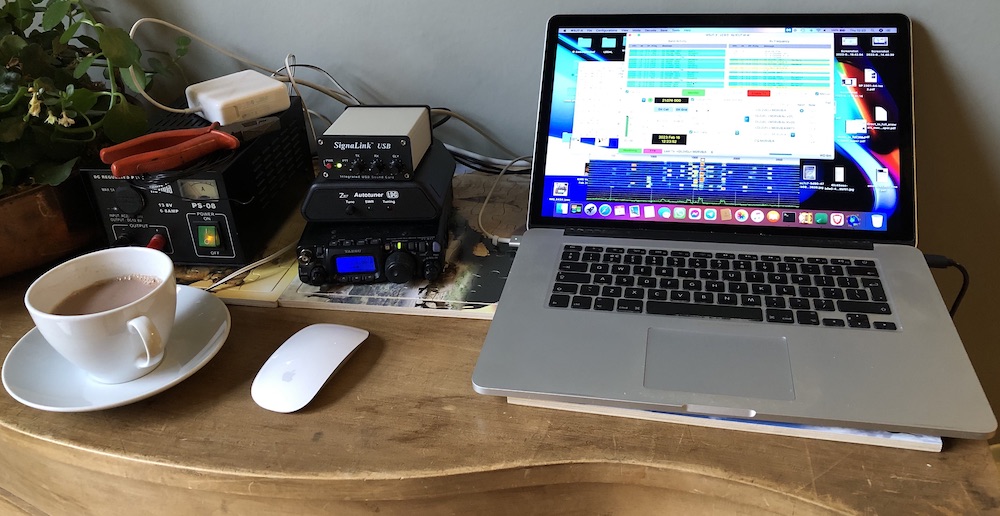
So I finally managed to set up and work /A for a couple of days. The setup failed really as the house we were in had very thick stone walls and no opening windows so the antenna was literally a bit of wire diagonally up from an un-un on the floor, around the back of a sash window cord and across to a picture. But I managed 4 FT8 QSOs, one on 24MHz and three on 21MHz. Better than nothing, and time to learn better about portable compromise antennas. I could have set up in the garden but it was mostly raining and I didn't bring any batteries.
You should also read:
4m FT8, a first for me
Had my first 70MHz FT8 QSO today, and I think the third anything on 4m because there's little activity here on FM and I only just got the transverter. There was a surprising spot at -23db and 1,443km to Poland but then an actual QSO with a Welsh station at 126km. So the converted 'FM radio' dipole in the loft works, as does the transverter.
Continue reading...First experiments with the FTM100DE
Well I got up relatively early and cut 35 foot of WF103 and soldered a PL259 on one end. The hole in the ceiling above the radios won't take the width of a plug but will - just as it turned out - take the cable. It now has one run of RG213 and three of WF103 and an RG58 and I reckon nothing else is going up that way now. My little Antex iron had no chance against the copper in the WF103 so I had to drag the reflow machine in from the workshop, overkill but it made a good joint. Got the co-linear set up and mounted and the VNA said 1.2 SWR on 2m (it only goes to 180MHz). The radio was easy to install and is smaller than I'd imagined (but then I'd not taken any notice of the stated dimensions). I put the SWR meter inline and it agreed with the 1.2 SWR on 2m and said the same for 70cm. The first thing the rig did was tell me that the micro SD card I fitted is bust so its in the bin. Another one worked fine. Mind you, I should have realised because I had one SD card that would not boot pi-star no matter how I tried - I guess its the same one. Other than that it does what they say it will and works fine in both analogue and C4FM, receive-wise anyway. The FTM100DE is a neat little thing and fairly intuitive in its use. I've programmed in the two local repeaters, one 70cm fusion, the other 2m analogue and both work fine and safely stored in memory. Not actually talked on the radio yet apart from a couple of tests to see if I could get into the repeaters (no time today) but it seems all systems go and hopefully I'll be able to join in on the local natter net next week. Time to add YSF to the pi-star hotspot.
Continue reading...Another first for me - BPSK31
So... I moved the PC closer to the rig as I could not be bothered to make extension cables. I already had fldigi and flrig and these both worked well once I connected it all up. Lots of morse - I'm still learning so seeing it decoded is actually quite an aid. But then I found some unfamiliar patterns. These fldigi pages are really helpful - http://www.w1hkj.com/FldigiHelp-3.21/Modes/ as is G4UCJ's page at http://hfradio.org.uk/html/digital_modes.html and I soon discovered lots of BPSK31 and BPSK63 signals around 14.070. Yup, I still only have wires up for 14MHz and 50MHz... I tried answering some CQ calls to no avail. So I had a break and made those extensions so I could actually regain some desk space. I tried to answer more calls and noticed the tx power level stayed firmly at zero when I transmitted. After a couple of 'CQ tests' I could hear a hash on the ICR2 but no 'music'. Having then plugged the audio leads into the right holes (!!!) and adjusting the line out volume I managed some tx power movement and tones on the ICR2. After attempting lots of unanswered CQ calls I answered a CQ from an Italian station and he got straight back to me! So, BPSK31 done - not really, it looks like a neat mode, almost like the displays from 'the matrix' and all this for keys 31Hz bandwidth. Fldigi is a really good piece of software. I've set the macros up so I am ready to play more.
Continue reading...