
Latest tooling addition
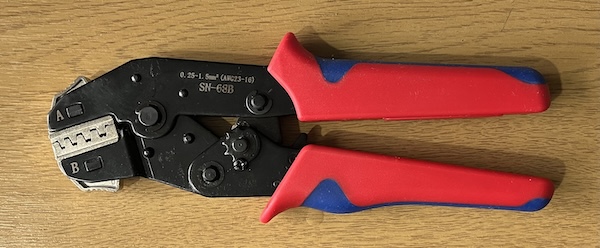
I had a number of Molex pins to wire up recently. To make things easier I decided to use some 4-core signal cable I had but found that the insulation is so poor at resisting heat that soldering the Molex pins was a non-starter as it always ended up with bare wires. Of course, Molex pins are designed to be crimped... so off to eBay.
The latest addition to my toolbox arrived in a couple of days and made the job a lot easier.
You should also read:
Latest timing addition
The latest addition to the shack is this diminutive DX Patrol GPSDO v.3 that arrived today from the Amsat UK shop. I was looking for a general 10MHz source to replace the one I built from a kit that is rather deaf and came across the DX Patrol ones. At first I found one that was set to 10MHz with four outputs but fortunately the Amsat shop sells one with four independently configurable outputs. The advantage of that is I can use one of them for the QO100 setup (assuming I ever get that finished!) as well as having a general 10MHz output. Frequencies can be set from a built-in web front end and this is accessed directly via a built-in AP plus an in-screen QR code (handy!). Once connected you can then use the web interface to connect the GPSDO to your own wifi, which is what I have done. One of the displays tells you what IP address it has which is also handy when trying to find it. I have yet to connect the NMEA output to anything - the documentation details this and also the device can function as an NTP server so I might use that as a backup to my main GPSDO NTP server.
Continue reading...New additions
A couple of new arrivals, a (new) Yaesu FTM510D and an (old) Yaesu FRG9600. On the FTM510D it is unheard of for me to actually get something so new. New, yes, but usually at least a year after launch. But this is new new. I was actually about to order a FTM500D when, fortunately the advert for this poped up. And it is way ahead of my FTM100D that this is replacing. First off, I like the display. it's big but not too big, colourful and gives all the right information. Not shown here is the information you see from a memory chanel which includes the callsign (or whatever you program in), frequence, mode and tone. It seems to find the GPS a lot faster than the FTM100D or my FT5D. There are, of course a lot of variables, for example cold start times, or the fact that somehow the shack finds GPS hard despite the perfect sky view from SE to SW. (Mobile phones never seem to have an issue). But the FTM100D would sometimes not find a GPS signal in hours. The FT2D was even worse. I like the controls too, with volume top left and press for squelch. Menus are all easy to read, with the Func button top right having a quick press to a user definable short menu or long press for the full menu. The only downside for me, and this is due to how I installed it, is the top row of 6 buttonw cannot be read from my chair. But as one is power that leaves just 5 to memorise, hardly taxing. So, out with the new and in with the old, an FRG9600 scanner. I wanted a general VHF/UHF scanner for a while now and this one came up via a ham radio exchange website. Old but still very usable. For this, I rebuilt the discone in the loft that I had removed some time ago. I have yet to program the radio up - mostly with local airport frequencies and frequencies of the airways and such. I like this because although I have SDRs which are far more capable, this one I can just switch on at will with everything else off. It runs on a 12V PSU which is always on rather than the big PSU that runs the rigs.
Continue reading...